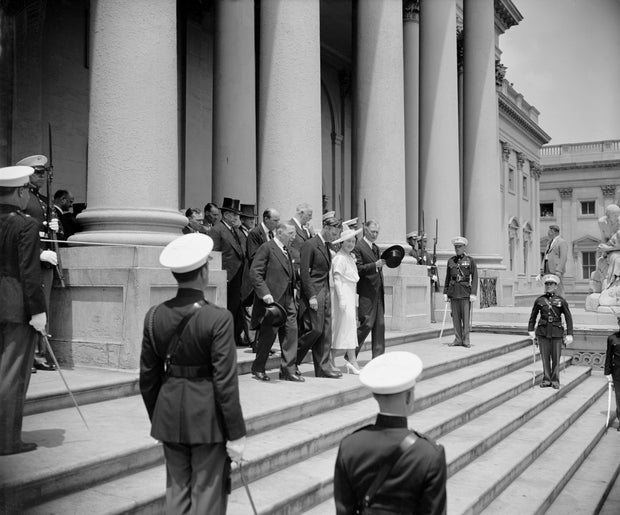
In grainy black-and-white frames and crisp 4K stills, British royals have stood on U.S. soil for nearly a century—shaking hands, sipping tea, and forging soft power one smile at a time. These moments, captured in photographs, are more than nostalgia. They are visual records of diplomacy, cultural exchange, and the evolving relationship between two nations bound by language, history, and occasional tension.
As King Charles III embarks on a state visit to the United States, the spotlight turns once again to the legacy of royal presence on American soil. The images of past visits—some triumphant, others awkward, all significant—offer a lens into how the British monarchy adapts, performs, and persists in the world’s most scrutinized democracy.
The First Royal Footprint: George VI and the 1939 Visit
It began with a king who never expected to rule. George VI, thrust onto the throne after his brother’s abdication, arrived in June 1939 with Queen Elizabeth at his side. Their visit wasn’t just symbolic—it was strategic. Europe teetered on the edge of war, and Britain needed American goodwill.
Photographs from that trip are now iconic: the royal couple laughing over a barbecue at Franklin D. Roosevelt’s home in Hyde Park, the King in a relaxed sport coat, the Queen smiling beside a sizzling grill. These were not the stiff portraits of empire, but images of approachability. The royals were shown eating hot dogs—a small gesture, but one captured in widely circulated photos that humanized them for American audiences.
This was the first time a reigning British monarch had visited the U.S. The optics mattered. Film reels showed George VI laying a wreath at the Tomb of the Unknown Soldier, touring the New York World’s Fair, and addressing Congress with a quiet dignity. The visit succeeded not through spectacle, but through sincerity—recorded meticulously by photographers at every turn.
Elizabeth II: The Queen Who Returned Again and Again
No royal has visited the United States more than Queen Elizabeth II. Over seven decades, she made 26 trips—formal and informal—each one shaping the public image of the monarchy in America.
Her 1957 visit, just five years into her reign, set the tone. Arriving at Washington National Airport, she was greeted by President Eisenhower. Photographs show her waving confidently from an open car, crowds three-deep along Pennsylvania Avenue. She addressed a joint session of Congress—the first British monarch to do so—her speech emphasizing shared values and postwar cooperation.
Later visits layered complexity onto her image. In 1976, during the U.S. bicentennial, she toured Boston, Philadelphia, and New York. Photos from this trip—particularly one of her waving from a horse-drawn carriage in Philadelphia—struck a delicate balance between celebration and historical awareness. She even joked about the tea dumped in Boston Harbor.
By 2007, for the 400th anniversary of Jamestown, her presence was ceremonial, but the photographs conveyed continuity. At age 81, she stood beside President George W. Bush, both smiling at a reenactment of early colonial life. The contrast between the past and present was implicit: the monarchy that once ruled the colonies now celebrated their independence.
:max_bytes(150000):strip_icc():focal(728x275:730x277)/princess-catherine-prince-william-donald-trump-king-charles-iii-trump-state-visit-uk-windsor-091725-8672599a27214b6f8ffdbb07fd7596e4.jpg)
Each visit was a study in controlled symbolism. The images showed her in military uniforms, ball gowns, and casual attire—always composed, rarely revealing. Yet the cumulative effect of these photos was profound: Elizabeth became a familiar, almost timeless figure in the American imagination.
Prince Charles: From Controversy to Statesmanship
Long before he was king, Charles charted his own path in U.S. relations. His first solo visit in 1970, at age 21, drew protests over British policy in Northern Ireland. Photographs from that trip show a young prince flanked by police, walking through hostile crowds in Belfast before flying to New York—where he attended a glittering dinner at the Met.
But it was his environmental advocacy that defined his later American presence. In the 1980s and 1990s, Charles toured sustainable farms, spoke at universities, and met with climate scientists. Photos from these trips often showed him in tweed, kneeling in soil or inspecting organic crops—deliberate visuals reinforcing his identity as a green-minded traditionalist.
One notable moment came in 2011, when he and the Duchess of Cornwall visited the White House. A now-famous image captured Michelle Obama laughing while Charles leaned in too closely for a greeting. The photo went viral—gently mocked, but ultimately endearing. It showed the human slip-ups behind royal protocol, and how images can reshape perception in seconds.
William and Kate: The Modern Royal Brand When Prince William and Catherine, Duchess of Cambridge, arrived in 2011 for their first official U.S. tour, the media frenzy was intense. They were young, photogenic, and seen as the future of the monarchy.
Photos from their trip blended diplomacy with celebrity: William at the Inner Harbor in Baltimore, discussing conservation; Kate in a red dress at a black-tie event in California, receiving praise for her poised elegance. Their 2014 return—focused on mental health awareness and wildlife conservation—cemented their image as socially conscious royals.
But their most telling American moment came in 2022, when they attended a memorial event for the 9/11 attacks. A solemn photo showed them standing beside survivors and first responders at the World Trade Center site. No words were needed. The image communicated respect, empathy, and alliance—a quiet counterpoint to the glitz of their earlier visits.
The Power of the Photograph in Royal Diplomacy
These images do more than document—they influence. A single photograph can soften centuries of colonial tension, bridge political divides, or spark a public relations crisis.
Consider the optics of a royal eating a hot dog in 1939 versus Charles III sipping craft beer at a local brewery today. Both are calculated, both are symbolic. The monarchy understands that in the age of instant media, visual storytelling is diplomacy.
Photographers don’t just capture moments—they shape narratives. The angle of a smile, the choice of outfit, the setting of a handshake: all are choreographed to convey warmth, authority, or humility. When the Queen wore a brooch shaped like the Statue of Liberty in 1976, or when Kate wore an American designer to a state dinner, the messages were subtle but deliberate.
And yet, the most powerful images often come from unscripted seconds: a child handing a bouquet, a shared laugh with a president, a wave from a carriage. These are the frames that endure.
King Charles III’s State Visit: Continuing the Legacy

As King Charles III steps onto American soil for a state visit, the photographic stakes are high. This is his first such visit as monarch—the moment he transitions from prince to sovereign on the global stage.
Expect images designed to balance tradition and modernity. He will likely lay a wreath at Arlington, attend a state dinner at the White House, and speak on climate change—his lifelong cause. Camilla, now Queen, will stand beside him, her presence a quiet assertion of loyalty and longevity.
But the visit also carries risks. The monarchy faces scrutiny over its colonial past, its wealth, and its relevance. Photos that once charmed may now be dissected for symbolism: who they meet, where they go, what they wear.
Still, the history is on his side. Past visits prove that a well-managed royal tour can generate goodwill, reinforce alliances, and humanize a centuries-old institution. And in an era of deep political division, the image of a British monarch standing with American leaders—regardless of political party—can feel reassuring.
What These Images Reveal About the Monarchy’s Role
The archive of royal visits to the U.S. shows a monarchy in constant negotiation—with history, with public opinion, with change.
The photos trace an evolution: from imperial formality to democratic familiarity, from wartime alliance to cultural partnership. They show royals not as distant figures, but as performers in a global theater where image is everything.
Yet beneath the polish, these images also expose vulnerabilities. The monarchy must constantly justify its existence. Every visit is an audition. Every photograph a referendum.
But they keep coming. And America keeps photographing them.
Closing: The Enduring Image of Royalty in America
King Charles III’s visit will add new frames to a century-long visual narrative. Whether it’s a handshake with the president, a moment with schoolchildren, or a toast under crystal chandeliers, the images will speak louder than speeches.
For those covering the visit or analyzing its impact, the lesson is clear: never underestimate the power of a single photograph. It can reconcile nations, redefine a legacy, or become the moment history remembers.
Watch the photos closely. They don’t just show a king in America—they reveal how the monarchy survives.
FAQ
Did any British monarch visit the U.S. before George VI? No. George VI was the first reigning British monarch to visit the United States in 1939.
How many times did Queen Elizabeth II visit the U.S.? She made 26 official visits to the United States between 1951 and 2011.
What was the purpose of King Charles III’s state visit? The visit reinforces U.S.-UK diplomatic ties, addresses climate change, and celebrates shared cultural and historical connections.
Are royal visits to the U.S. funded by American taxpayers? No. Royal visits are typically funded by the British monarchy or private sponsors, not U.S. public funds.
Why are photographs so important during royal visits? Photos shape public perception, convey diplomatic messages, and create lasting historical records of international relations.
Did Prince Harry and Meghan visit the U.S. as senior royals? Yes. They visited multiple times before stepping back, including a 2018 tour and events in New York and California.
Can the U.S. invite a British monarch for a state visit? Yes. State visits are formally extended by the U.S. president and coordinated with the British government.
FAQ
What should you look for in Royal Visits to America: A Photographic Legacy? Focus on relevance, practical value, and how well the solution matches real user intent.
Is Royal Visits to America: A Photographic Legacy suitable for beginners? That depends on the workflow, but a clear step-by-step approach usually makes it easier to start.
How do you compare options around Royal Visits to America: A Photographic Legacy? Compare features, trust signals, limitations, pricing, and ease of implementation.
What mistakes should you avoid? Avoid generic choices, weak validation, and decisions based only on marketing claims.
What is the next best step? Shortlist the most relevant options, validate them quickly, and refine from real-world results.